Archive for July, 2010

h1

Identity as Paradox

July 28, 2010

Posted by Kanga.

Identity is a bit murky in the United States, however, it is nothing to the confusion in the U.A.E. In the U.S., just being born on the soil makes you a citizen. If you are not born there, it is possible to be naturalized by going through a detailed process or marriage to a citizen. The U.S. is a large piece of real estate, in case you haven’t noticed, so there are many identities within the overall American identity – yankee, southerner, Asian American, Hispanic, Native American, African American, residents of 50 distinct states, etc. Hundreds of ways to label oneself. But, when all is said and done, you can rest in being an American. (My apologies to Canadians, Central Americans and South Americans. I admit we are rather arrogant to refer to ourselves as if we were the only Americans.)

In the U.A.E., however, it is a very different story. Citizenship was created in 1971 and was given to many residing here, although not all. Citizenship by birth is given only to those whose fathers are citizens. Very few of the children born on this soil are citizens. Citizenship cannot be attained by any form of naturalization process. Not even marriage to a citizen results in citizenship, although I did read one reference to a citizen male being able to obtain citizenship for his wife (but not vice versa). In addition to being a recipe for a dwindling citizenship, this is also the cause of identity confusion for the many of non-citizens who have lived here all their lives.

Very early on we began to meet young people who have grown up here, but have to refer to themselves as Pakistani, Indian, Canadian, or whatever nationality their parents have, even though they have only visited their “homeland.” Culturally, they are… ??? There is not a word for it, no label. Some have attempted to create a label, like Dubaian, Dubai-ite, but nothing has stuck. They must be considered expats (expatriates – legal alien residents) just like the rest of us who have only arrived a short time ago.

In the video at this link Neither Here nor There a young Sudanese woman talks about the dilemma of being an expatriate both here and in her home country.

h1

Silsila

July 27, 2010

Posted by Kanga.

Bollywood Review #4

Silsila, starring Amitabh Bachchan, Jaya Bhaduri, Rekha, and Shashi Kapoor, 1981.

This begins as the story of two brothers who have grown up as the best of friends. Shekhar (Shashi) is a fighter pilot. Amit (Amitabh) is a playwright and poet. Shekhar is engaged to Shobha (Jaya) and Amit is just falling in love with Chandni (Rekha). These brothers have done everything together (even a shower scene with a “pick up the soap” joke) and when Amit calls to tell Shekhar of his love for Chandni, they agree that they must have a joint wedding. Unfortunately, Shekhar puts down the phone and heads for his fighter plane, never to return. He is shot down and killed in action, leaving both Amit and Shobha grieving. Amit discovers that Shobha is pregnant with his beloved brother’s child and will be shamed when this becomes public. He does a gallant thing and marries her instead of Chandni. He writes Chandni a “dear jane” letter, although not explaining why he is deserting her.

Tragedy and difficult to believe coincidence changes the direction of this tale. Amit & Shobha are in a car accident, she miscarries AND her doctor is none other than Dr. Anand, the new husband of Chandni whom she married after being dumped by Amit. Chandni’s husband is devoted to her, but knows that this devotion is not returned by her. He even complains that she doesn’t fight with him.

Due to this coincidental crossing of their paths Chandni & Amit are “reunited” and Amit can’t let it go. He continues to meet with Chandni in clandestine trysts always having to duck people who recognize them. Their spouses aren’t stupid and soon catch on to what is happening, but try their best to preserve their marriages.

Amit decides to take the plunge and break up their marriages and go away with Chandni. This does not work out as well as he thought it would as they begin to have second thoughts due to society’s dim view of their infidelity. Then tragedy strikes, yet again. Chandi’s husband is in a plane crash. They rush to the site to find out what has happened to him. Shobha is there, too, and attempts to stop Amit from running into the fire to find Dr. Anand by admitting that she is once again pregnant. What will she do if she loses him. Amit rescues Dr. Anand and returns to Shobha declaring his devotion to her. The movie ends with the declaration that “Love is faith and faith is forever.”

I have to say this is the first movie where I haven’t liked Amitabh’s character. He does a very honorable thing and then completely negates it by being a selfish jackass. Once he’s caught by Shobha and others, he gets all whiny and carries on about how this is not his fault. It is one thing to make bad choices and do stupid things and a whole ‘nother level of bad to refuse to take responsibility for those choices and actions. When Chandni says she can’t continue being torn between her husband and lover, Amit says “I’m sick and tired of your fears and your apprehensions!” Wow, how much more selfish can he get? He has a really heinous speech when he breaks up with Shobha where he tells her that for him their relationship is bondage, to which she replies that she has fallen in love with him. Ouch! Shobha is the definition of longsuffering.

Amitabh’s acting is impecable which is probably why I dislike Amit so much. Shobha should have slapped him upside the head.

More info at the Internet Movie Database: http://www.imdb.com/title/tt0083081/

h1

Bulls Butting Heads

July 26, 2010

Posted by Kanga.

Here’s another video of the Fujairah bull butting. Explains a little more about how it works.

Gulf News – Bull Fighting – Hooved Gladiators Lock Horns in Fujairah

To see our previous posts on the bull butting – click here.

h1

Predictions of Future Past

July 24, 2010

Posted by Kanga.

This has nothing to do with “living the travel channel.” It’s just what I’ve been thinking about lately.

A long time ago (1992) when I was in graduate school learning to become a librarian, we were shown a short video that predicted the future of information.
First let me set the scene:

  • This was pre-graphical Internet browsers. (Mosaic was another amazing demonstration at the time, but there was no Internet Explorer, Firefox, or whatever.)
  • We were using Pine for email.
  • We were posting things to “bulletin boards” and usenet. (I remember spending hours reading the leaked script to the Star Trek Generation movie and being disappointed.)
  • There were no images, no videos, no animations, no search engines.

The video we were presented with showed a business man getting up in the morning and having a relaxing cup of coffee while his computer generated “information butler” (my terminology) told him verbally about news reports he might find relevant, gave him the stock report on his investments, told him his schedule for the day, and responded to the man’s verbal feedback. All those things that personal assistants do for the rich and powerful. The message for us apparently was that we had just signed up for a profession that would soon cease to exist. I looked on YouTube for this video, but that is like looking for a needle in a very big haystack with my eyes closed.

Happily, 18 years later, the death of the librarian profession has not been realized. We still don’t have artificial intelligence and we still need people to organize, channel and disseminate information. (We still need people to figure out why the computer system isn’t giving us what we want when we want it.)

There are things like RSS feeds that we are supposed to use to glean information we want from the overwhelming mess called the internet, but only a few use them (the info savvy). Even I haven’t taken the time to set this up for myself (mainly because I expect to be deluged with more info that I can possibly handle). I’m a secondary consumer, I suppose. I rely on my Twitter friends who are using their RSS feeds to find out what is happening in the world. They then share the link via Twitter and if their comments catch my eye and I think I might be interested in the information, I follow the link and read for myself. I’ve found some really important information that way.

In a way, the Internet is seriously inbred. For example, someone out there writes something interesting. Someone reads it and channels it in my direction. I find it interesting and useful for others, so I put it in a wiki or a blog for further distribution. Search engines index my wiki enabling others to find it and before long my wiki is linked to someone else’s wiki or website. Etc., etc., etc.

In the spirit of inbred Internet, here is a link I think you might find interesting. The Internet in 1969 via the Huffington Post

h1

Cat: Genius or Idiot?

July 23, 2010

Posted by Kanga.

Here is Oliver’s latest feat of entertaining silliness. It is amazing what can be accomplished with a few balls and a laundry basket.

I started filming this because he was looking at the string on the side of the basket and clearly thinking about how to get it off or what to do with it. It quickly turned into a whole different game, however. Notice that it is not really about the balls. He can get to them when ever he wants. Once they are out of the basket they are no longer of interest. It is all about the basket. And, Bert just quietly looks on.

h1

Not as appetizing as they may have thought…

July 15, 2010

Posted by Kanga.
bag of snacks called Chicky Chips

Somehow, the thought of eating that sweet little chick…

package of candy called Burfi

Burfi turned out to be a hypersugar bar.

package of cheese snacks called Fonzies

Ayyy…Mrs. C!

h1

Paheli

July 9, 2010

Bollywood Movie Review #3

Paheli, starring Shahrukh Khan, Rani Mukherjee (and a cameo by Amitabh Bachchan), 2005.

Paheli (which means Puzzle) is based on a Rajasthani folktale. I don’t know the folktale, so will not be able to address how the movie is faithful or divergent from it. This is a  visually stunning movie with wonderful settings and costumes – beautiful saris and amazing turbans.

We begin with Lachchi, a young girl from a fairly wealthy family who is preparing for her marriage to a promising young man, Kishan. The groom and his family arrive to convey Lachchi to her new home some miles away. On the trip, they stop at a well to rest and eat briefly. This well, however, is haunted by many ghosts. One of these ghosts sees Lachchi and falls in love with her.

As the journey continues it becomes evident that the bridegroom is not very interested in his marriage or bride. He is pouring over the accounts for the wedding expenses, because they don’t add up and he must resolve the discrepancy. Once they arrive in the bridal chamber, his preoccupation with the accounts continues and, much to Lachchi’s dismay, it comes out that Kishan will be leaving in the morning to travel to another city to run his father’s trading business there and will return after 5 years! No point in “igniting passions” (and not much point in having gotten married either). Lachchi is to stay behind, serve his parents and wait for his return.

As planned, Kishan leaves the next morning on his “five year mission.” He travels back by the same well where they had stopped the day before. The ghost who fell for Lachchi sees him and recognizes him. Why is the bridegroom abandoning his bride so soon?! The ghost decides to take advantage of this foolishness, takes human form identical to Kishan and returns home to Lachchi. The family is surprised to see him back so soon. Ghost Kishan convinces the father to accept his return with a story of how he met a sage who granted him a boon saying that every morning when he wakes he will find 5 gold coins. What matters to the father is wealth, so he accepts this explanation and allows Ghost Kishan to stay.

Lachchi is very happy to see her new husband returned so soon and hopes for a proper wedding night. To his credit, Ghost Kishan is up front with her and tells her the truth that he is not her husband, but a ghost who loves her so deeply that he has gone to this extreme to be with her. He gives her the option to accept him or send him away. She opts to keep the ghost lover rather than have no husband at all.

So, years pass as Ghost Kishan and Lachchi live happily together and the real Kishan toils away in a faraway city, completely unaware.

As time wears on – the real Kishan begins to long for his home and new bride. Meanwhile, Lachchi is having Ghost Kishan’s baby. The plot thickens and comes to a climax. Real Kishan returns home just as Lachchi goes into labor. The family spends a lot of time pondering the puzzle of TWO Kishans. Finally, they decide to travel to the King to have it resolved. On the way, they encounter a shepherd (Bachchan) who offers to solve their problem. He offers three tests to determine who is the true husband (and who is the true lover) of Lachchi. The Real Kishan is revealed and the Ghost Kishan is “trapped” in a water skin. All return home.

Lachchi is now faced with yet another “wedding night” this time with the Real Kishan. To her credit, she is up front with him and tells him that she knew all along that it was not him, but a ghost impersonator. She admits how deeply she loved the ghost and that she doubts that she can ever love Real Kishan. At which point, Kishan discloses that he is the ghost (not trapped at all) who has now taken over the body of the real Kishan, so they can live happily ever after together.

I’ve watched this twice. After the first viewing, I watched the “making of” special feature and was surprised to find that they thought this was a story about the empowerment of a woman. My western mindset said “Huh?!?” So, I had to watch it again. From a western point of view, this is a woman who can be talked into anything, who is blown about on the winds of external forces. From the eastern point of view, however, it is different. I think the key is in that scene where Ghost Kishan tells her the truth and gives her the option to decide. She disregards societal rules that would have dictated that she refuse this lover and remain faithful to her dud of a husband, no matter what.

There are a couple of puppets who seem to be connected with the ghost (his parents, perhaps) who appear occasionally to explain things. One of their dialogues points out that the bride is subject to the desires of the husband, the husband is subject to the desires of the father, and the father is subject to the desire for wealth. Lachchi breaks this chain by asserting her desire to be genuinely loved.

Another clue to her “empowerment” is the fact that she is truthful with the final incarnation of Kishan instead of taking refuge in the assumption that she was fooled by the ghost.

So, a western feminist has to look very hard to see a positive message for women. If we were to write it, she would have taken one good look at her dud of a husband, said “no thank you,” gone back home and gotten a career or at least waited until someone better came along.

(Indian movies seem to be obsessed with romance. It’s all about the falling in love. They are very poetic and free with “your eyes are like limpid pools” type talk. However, not even kissing is portrayed in the movies. The leads will start to lean in for a kiss and another character will interrupt or there will be a carefully placed umbrella to hide the kiss. It strikes me as strange that a culture with a long tradition of arranged marriages would be so entranced by romance. Maybe that makes all the sense in the world.)

The movie’s official page – http://www.redchillies.com/paheli/index.asp

Info at Wikipedia – http://en.wikipedia.org/wiki/Paheli

Info at Internet Movie Database – http://www.imdb.com/title/tt0451850/

h1

On a Sandy Day You Can’t See Forever

July 8, 2010

Posted by Kanga.

Wednesday we took our first trip to the observation deck of the Burj Khalifa, world’s tallest building. I say first trip, because we will probably go back at least twice more – once on a clear day and again at night. It costs 100 AED per person ($27.00) and is worth the price.

My ears popped during the elevator ride, but it was a very fast (1 minute) and smooth ride. It was almost like riding in Charlie’s glass elevator, not because it was glass, but the walls were very shiny and there were multiple video screens built into the elevator walls showing views as we moved up.

Along the way from the entrance to the elevator and again from the elevator to the exit, there were excellent informational displays about the building of the Burj.

It is summer and that means that sand is blowing around. The haze in the photos is not smog, but sand. It is just that season.

northwest view from the Burj Khalifa
Above is the northwest view showing the Metro train station in the foreground and the Arabian Gulf in the distance.

north view from Burj Khalifa observation deck
Above is the view to the north showing the skyscrapers clustered around Sheikh Zayed Road.

view of the roof of Dubai Mall
Above is the view to the east of the roof of the Dubai Mall, one of the largest malls in the world.

view of the Address Hotel and Business Bay
Above is the Address Hotel and in the background is the Business Bay – artificial extension of the Dubai Creek. The waterway will eventually extend to the Arabian Gulf making a complete circuit.

aerial view of Dubai Fountain
Above is the view of the Dubai Fountain. As you can see it has a complex system of spouts. It “performs” to music. It is very impressive to see. Also, as you can see it has an impressive crop of algae. Below is a man cleaning the fountain. You may need to click on the picture to enlarge it to see him.

man cleaning the fountain
The observation deck it not at the top of the burj, but only the 124th floor. There is an outdoor deck where you can get unobstructed pictures (no reflection off the windows) and an air conditioned indoor deck.

view up to the top of the building from the observation deck
This is the view up from the observation deck to the top of the building. Below is us on the outdoor deck, reflected in the windows.

h1

For the person who has everything…

July 8, 2010

Posted by Kanga.

Yes, here’s the solution to that gift giving conundrum you’ve been struggling with – a horse lamp.

a life-size horse statue with a lamp coming out of it's head

We took this picture months ago. It was part of some shopping promotional. A completely coordinated living room was placed in the hallway of the mall.

sideview of the horse lamp

What you can’t see in these pictures is that the horse is anatomically correct, including an anus. He’s not overly endowed – wouldn’t want to be tacky, after all.

h1

Baghban

July 7, 2010

Bollywood Movie Review #2

Posted by Kanga.

Baghban, starring Amitabh Bachchan, Hema Malini, Salman Khan, 2003.

For me, this was a big tear jerker. Amitabh and Hema were wonderful as Raj and Pooja Malhotra, an older couple very much in love. They have four biological sons, three daughters-in-law, two grand children and one adopted son. Their children love to come and visit during holidays and enjoy the luxury of asking Daddy for money when they need it.

Raj is approaching retirement and his children are unaware that he has spent his retirement savings on funding their wants and needs. Raj’s retirement plan is to be taken care of by his wonderful children in return for having given them a good start in life. This is a shock to the selfish children who then decide to agree with a stipulation – their parents must stay with different sons. They assume that their parents who have not been separated for forty years will refuse this and opt to stay together in their own house (where they belong). However, their parents agree to the separation, spoiling the plan. They pack their bags, say a tearful goodbye and go their separate ways with each of the two oldest sons. The next six months are spent showing us just how awful and selfish these sons and daughters-in-law are.

<<Remember, I include spoilers, so if you don’t want to know how it all turns out, stop reading now.>>

After the six months, the parents pack up and get on trains to travel to the respective homes of the other two biological sons. However, Raj has a plan. Their trains will pass through the same train station within 5 minutes of each other. Raj instructs his wife to get off at this station and they will meet. There are all kinds of coincidences – this happens to be their wedding anniversary and the town where they spent their honeymoon. It also happens to be the town where their adopted son and his new wife have settled. The adopted son has been looking for them finding their lifelong home locked up and empty, not knowing where they had gone. He takes them home and shows them the respect and love they have not received from their biological children.

Raj, however, thinks that they must return to their old house. He is not quite ready to be dependent, just yet. Upon returning home, Raj discovers that friends have taken the book he wrote while separated from his wife and submitted it to a publisher. Raj becomes an award winning author and receives substantial royalties.

NOW, his biological children perk up and try to figure out how to get back in Daddy’s good graces and get a piece of the inheritance pie. This does not work out for them, however, because Raj is not the forgiving type. He is content in the love of his wonderful wife, his adopted son and his grandchildren, who unlike their parents, valued and loved Raj and Pooja.

So, why did I like this movie so much? It’s obviously meant to teach us a lesson and could have been very heavy handed and burdensome. In fact, some of the over the top behavior of the sons and their wives was extreme. Even the adopted son is a bit gushy in his praise and adoration of his parents. The riches here are in the relationship of Raj and Pooja.

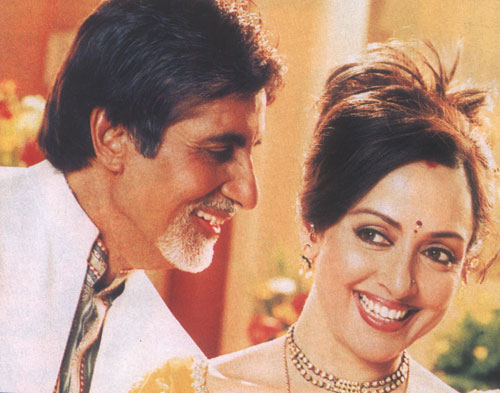
Bachchan and Malini

They are not just used to each other or living together out of habit. They genuinely love each other. The first part of the movie establishes this well, then it is reinforced by the scenes of them speaking on the phone or writing letters to each other, of Raj waiting eagerly for the sound of the mail delivery. There is a wonderful scene where Raj sneaks out of the house to use a pay phone to call Pooja and he sings her a song that just breaks your heart.

Yeah, this is a movie about not being bad children, but I think it is really about being a great husband and wife.

(If Amitabh looked at me like that, I’d fall. Hema Malini – in the words of DaddyBird “stunning.” Salman Khan, however, did not find and excuse to take of his shirt.)